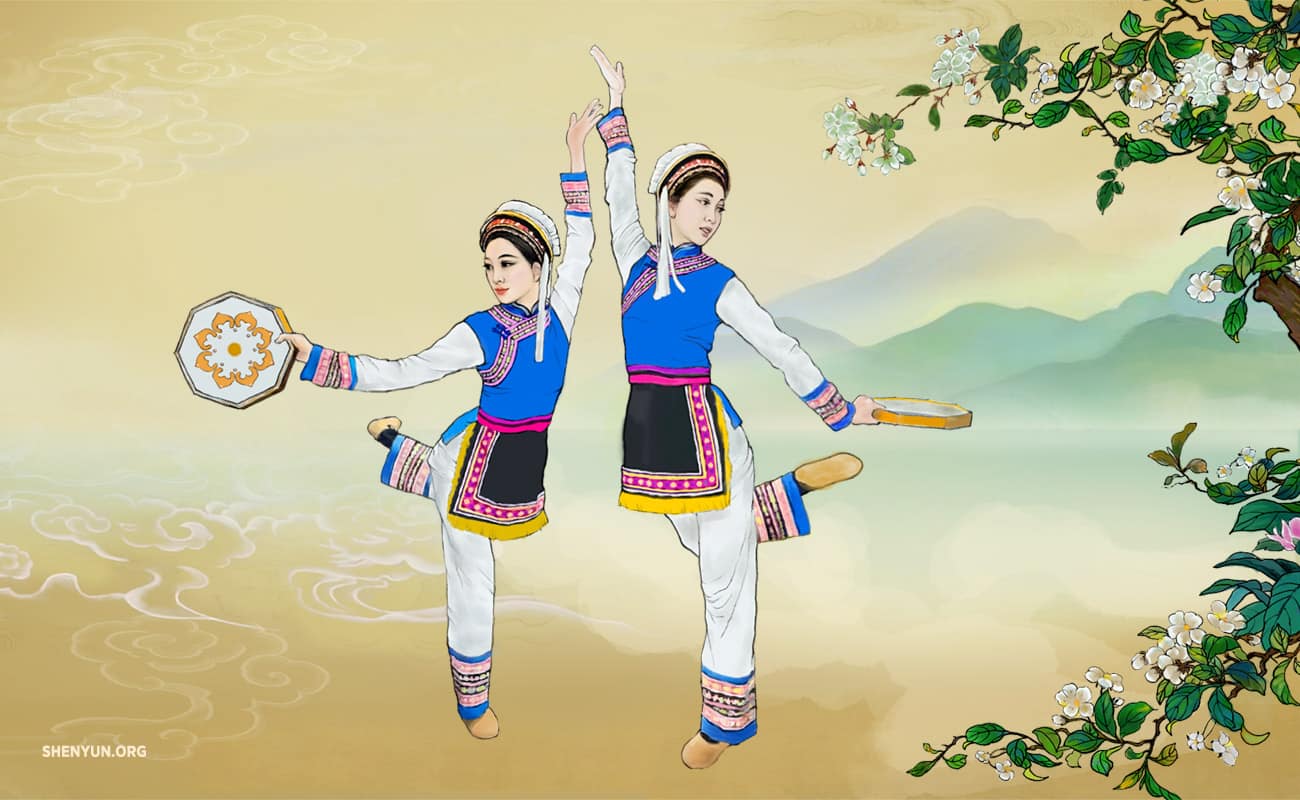
Bai Ethnic Dance
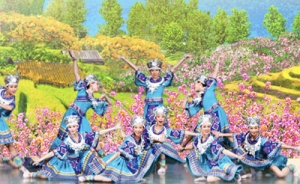
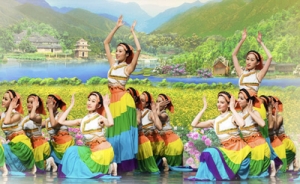
The Bai people are a minority ethnic group from southwest China, living primarily around Erhai Lake in today’s Dali region of Yunnan province. With a history of over a thousand years, the Bai developed distinct customs, architecture, and dance styles.
The word “bai” means the color white, and indeed the Bai favor white jackets, embroidered trims, and headscarves during their festivals and important celebrations.
One of the Bai’s most representative folk traditions is the bajiao drum dance, performed with small, hand-held octagonal drums. The drum is struck with the palm or tapped against different parts of the body—shoulders, hips, knees, or even feet—to produce bright, rhythmic sounds. Although the striking patterns are simple, they create a lively beat that gives the dance its distinctive energy.
Bai dancers often move with light steps and open motions that match the rhythm of the drum. As the rhythm builds, dancers weave in small hops, turns, and coordinated accents that highlight both the drum and the dancer’s agility.
The bajiao drum dance remains a cherished symbol of Bai culture today, expressing joy and a deep sense of community. This fun dance is still performed during communal celebrations like fairs, housewarming parties, weddings—and Shen Yun shows.
This distinct octagonal drum dance is featured in Shen Yun’s 2026 the Ethnic Dance of the Bai, choreographed by Hui Xuan with music composed by D.F. and arranged by Gao Yuan.